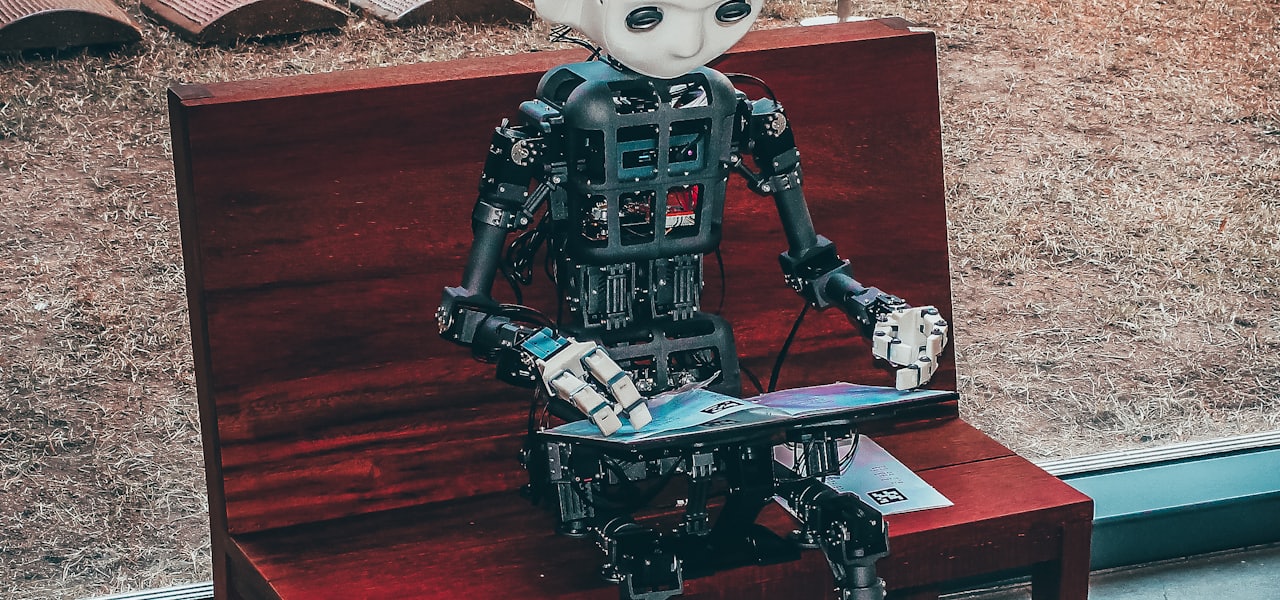
A Gödel machine is a hypothetical self-improving computer program that solves problems in an optimal way. It uses a recursive self-improvement protocol in which it rewrites its own code when it can prove the new code provides a better strategy. The machine was invented by Jürgen Schmidhuber (first proposed in 2003), but is named after Kurt Gödel who inspired the mathematical theories. The Gödel machine is often discussed when dealing with issues of meta-learning, also known as "learning to learn." Applications include automating human design decisions and transfer of knowledge between multiple related tasks, and may lead to design of more robust and general learning architectures. Though theoretically possible, no full implementation has been created. The Gödel machine is often compared with Marcus Hutter's AIXI, another formal specification for an artificial general intelligence. Schmidhuber points out that the Gödel machine could start out by implementing AIXItl as its initial sub-program, and self-modify after it finds proof that another algorithm for its search code will be better. == Limitations == Traditional problems solved by a computer only require one input and provide some output. Computers of this sort had their initial algorithm hardwired. This does not take into account the dynamic natural environment, and thus was a goal for the Gödel machine to overcome. The Gödel machine has limitations of its own, however. According to Gödel's First Incompleteness Theorem, any formal system that encompasses arithmetic is either flawed or allows for statements that cannot be proved in the system. Hence even a Gödel machine with unlimited computational resources must ignore those self-improvements whose effectiveness it cannot prove. == Variables of interest == There are three variables that are particularly useful in the run time of the Gödel machine. At some time t {\displaystyle t} , the variable time {\displaystyle {\text{time}}} will have the binary equivalent of t {\displaystyle t} . This is incremented steadily throughout the run time of the machine. Any input meant for the Gödel machine from the natural environment is stored in variable x {\displaystyle x} . It is likely the case that x {\displaystyle x} will hold different values for different values of variable time {\displaystyle {\text{time}}} . The outputs of the Gödel machine are stored in variable y {\displaystyle y} , where y ( t ) {\displaystyle y(t)} would be the output bit-string at some time t {\displaystyle t} . At any given time t {\displaystyle t} , where ( 1 ≤ t ≤ T ) {\displaystyle (1\leq t\leq T)} , the goal is to maximize future success or utility. A typical utility function follows the pattern u ( s , E n v ) : S × E → R {\displaystyle u(s,\mathrm {Env} ):S\times E\rightarrow \mathbb {R} } : u ( s , E n v ) = E μ [ ∑ τ = time T r ( τ ) ∣ s , E n v ] {\displaystyle u(s,\mathrm {Env} )=E_{\mu }{\Bigg [}\sum _{\tau ={\text{time}}}^{T}r(\tau )\mid s,\mathrm {Env} {\Bigg ]}} where r ( t ) {\displaystyle r(t)} is a real-valued reward input (encoded within s ( t ) {\displaystyle s(t)} ) at time t {\displaystyle t} , E μ [ ⋅ ∣ ⋅ ] {\displaystyle E_{\mu }[\cdot \mid \cdot ]} denotes the conditional expectation operator with respect to some possibly unknown distribution μ {\displaystyle \mu } from a set M {\displaystyle M} of possible distributions ( M {\displaystyle M} reflects whatever is known about the possibly probabilistic reactions of the environment), and the above-mentioned time = time ( s ) {\displaystyle {\text{time}}=\operatorname {time} (s)} is a function of state s {\displaystyle s} which uniquely identifies the current cycle. Note that we take into account the possibility of extending the expected lifespan through appropriate actions. == Instructions used by proof techniques == The nature of the six proof-modifying instructions below makes it impossible to insert an incorrect theorem into proof, thus trivializing proof verification. === get-axiom(n) === Appends the n-th axiom as a theorem to the current theorem sequence. Below is the initial axiom scheme: Hardware Axioms formally specify how components of the machine could change from one cycle to the next. Reward Axioms define the computational cost of hardware instruction and the physical cost of output actions. Related Axioms also define the lifetime of the Gödel machine as scalar quantities representing all rewards/costs. Environment Axioms restrict the way new inputs x are produced from the environment, based on previous sequences of inputs y. Uncertainty Axioms/String Manipulation Axioms are standard axioms for arithmetic, calculus, probability theory, and string manipulation that allow for the construction of proofs related to future variable values within the Gödel machine. Initial State Axioms contain information about how to reconstruct parts or all of the initial state. Utility Axioms describe the overall goal in the form of utility function u. === apply-rule(k, m, n) === Takes in the index k of an inference rule (such as Modus tollens, Modus ponens), and attempts to apply it to the two previously proved theorems m and n. The resulting theorem is then added to the proof. === delete-theorem(m) === Deletes the theorem stored at index m in the current proof. This helps to mitigate storage constraints caused by redundant and unnecessary theorems. Deleted theorems can no longer be referenced by the above apply-rule function. === set-switchprog(m, n) === Replaces switchprog S pm:n, provided it is a non-empty substring of S p. === check() === Verifies whether the goal of the proof search has been reached. A target theorem states that given the current axiomatized utility function u (Item 1f), the utility of a switch from p to the current switchprog would be higher than the utility of continuing the execution of p (which would keep searching for alternative switchprogs). === state2theorem(m, n) === Takes in two arguments, m and n, and attempts to convert the contents of Sm:n into a theorem. == Example applications == === Time-limited NP-hard optimization === The initial input to the Gödel machine is the representation of a connected graph with a large number of nodes linked by edges of various lengths. Within given time T it should find a cyclic path connecting all nodes. The only real-valued reward will occur at time T. It equals 1 divided by the length of the best path found so far (0 if none was found). There are no other inputs. The by-product of maximizing expected reward is to find the shortest path findable within the limited time, given the initial bias. === Fast theorem proving === Prove or disprove as quickly as possible that all even integers > 2 are the sum of two primes (Goldbach’s conjecture). The reward is 1/t, where t is the time required to produce and verify the first such proof. === Maximizing expected reward with bounded resources === A cognitive robot that needs at least 1 liter of gasoline per hour interacts with a partially unknown environment, trying to find hidden, limited gasoline depots to occasionally refuel its tank. It is rewarded in proportion to its lifetime, and dies after at most 100 years or as soon as its tank is empty or it falls off a cliff, and so on. The probabilistic environmental reactions are initially unknown but assumed to be sampled from the axiomatized Speed Prior, according to which hard-to-compute environmental reactions are unlikely. This permits a computable strategy for making near-optimal predictions. One by-product of maximizing expected reward is to maximize expected lifetime.
CodeSandbox
CodeSandbox is a cloud-based online integrated development environment (IDE) focused on web application development. It supports popular web technologies such as JavaScript, TypeScript, React, Vue.js, and Node.js. CodeSandbox allows users to create, edit, and deploy web applications directly from the browser with zero setup. CodeSandbox is widely used for front-end development, rapid prototyping, sharing code snippets, and real-time collaborative coding. It provides GitHub integration, templates for common frameworks, and a cloud-based development container for full-stack projects. == Templates == == Limitations == Slower performance for larger tasks compared to native IDEs Some features require a paid subscription Performance and storage limits for free-tier users Limited offline capabilities
Bob Coecke
Bob Coecke (born 23 July 1968) is a Belgian theoretical physicist and logician. He was Professor of Quantum foundations, Logics, and Structures at Oxford University until 2020. He was Chief Scientist at quantum computing company Quantinuum, until 2025 and founded a startup called Relational Intelligence in 2026. He is also Distinguished Visiting Research Chair at the Perimeter Institute for Theoretical Physics, and Emeritus Fellow at Wolfson College, Oxford. He pioneered categorical quantum mechanics (entry 18M40 in Mathematics Subject Classification 2020), Quantum Picturalism, ZX-calculus, DisCoCat model for natural language,, quantum natural language processing (QNLP) and quantum education through the book Quantum in Pictures. He is a founder of the Quantum Physics and Logic community and the Applied Category Theory communities and conference series, and of the journal Compositionality. Coecke is also a composer and musician, who has been called a pioneer of industrial music, and is also one of the pioneers of employing quantum computers in music. == Education and career == Coecke obtained his doctorate in sciences at the Vrije Universiteit Brussel in 1996, and performed postdoctoral work in the Theoretical Physics Group of Imperial College, London in the Category Theory Group of the Mathematics and Statistics Department at McGill University in Montreal, in the Department of Pure Mathematics and Mathematical Statistics of Cambridge University, and in the Department of Computer Science, University of Oxford. He was an EPSRC Advanced Research Fellow at the Department of Computer Science, University of Oxford, where he became Lecturer in Quantum Computer Science in 2007, and jointly with Samson Abramsky built and headed the Quantum Group. In July 2011, he was nominated professor of Quantum Foundations, Logics and Structures at Oxford University, with retroactive effect as of October 2010. He was a Governing Body Fellow of Wolfson College, Oxford since 2007, where he now is an Emeritus Fellow. In January 2019, Coecke became Senior Scientific Advisor of Cambridge Quantum Computing, and in January 2021 he resigned from his Professorship at Oxford, to become Chief Scientist of Cambridge Quantum Computing. After the merger of Cambridge Quantum Computing with Honeywell Quantum Systems, he stayed on as Chief Scientist of the joint entity Quantinuum until 2025. In January 2023 he also became Distinguished Visiting Research Chair at the Perimeter Institute for Theoretical Physics. == Work == Coecke's research focuses on the foundations of physics, more particularly category theory, logic, and diagrammatic reasoning, with application to quantum informatics, quantum gravity, and NLP. He has pioneered categorical quantum mechanics together with Samson Abramsky, and spearheaded the development of a diagrammatic quantum formalism based on Penrose graphical notation, on which he wrote a textbook entitled Picturing Quantum Processes with Aleks Kissinger. With Ross Duncan he pioneered ZX-calculus. He pioneered the DisCoCat model for natural language, with Stephen Clark and Mehrnoosh Sadrzadeh. He also pioneered quantum natural language processing (QNLP), with Will Zeng, and colleagues at Cambridge Quantum Computing. == Music == Coecke is also a musician, performing and recording since the eighties. He retrospectively has been named a pioneer of industrial music. His band, Black Tish, "used cutting edge sampling techniques for the time, a host of synth and sound loops and metal-style guitars to create a heavy rock/electronica fusion unlike anything heard before", and "bridge the gap between the pure experimental nature of bands like Throbbing Gristle and Einstürzende Neubauten and the (comparatively) more radio accessible Ministry or Nine Inch Nails". Coecke is also one of the pioneers of employing quantum computers in music. == Selected publications == Textbooks Bob Coecke, Aleks Kissinger:Picturing Quantum Processes. A First Course in Quantum Theory and Diagrammatic Reasoning, Cambridge University Press, 2017, ISBN 978-1316219317 Bob Coecke, Stefano Gogioso:Quantum in Pictures, Quantinuum, 2022, ISBN 978-1-7392147-1-5 Books (as editor) Bob Coecke, David Moore, Alexander Wilce (eds.): Current Research in Operational Quantum Logic: Algebras, Categories, Languages, Fundamental Theories of Physics, Kluwer Academic, 2010, ISBN 978-9048154371 Bob Coecke (ed.): New Structures for Physics, Lecture Notes in Physics 813, Springer, 2011, ISBN 978-3642128202 Articles Bob Coecke: Kindergarten quantum mechanics, arXiv:quant-ph/0510032 Samson Abramsky, Bob Coecke: A categorical semantics of quantum protocols, Proceedings of the 19th Annual IEEE Symposium on Logic in Computer Science, 2004, pp. 415–425 Bob Coecke, Ross Duncan: Interacting quantum observables, Automata, Languages and Programming, pp. 298–310, 2008 Konstantinos Meichanetzidis, Alexis Toumi, Giovanni de Felice, Bob Coecke: Grammar-Aware Question-Answering on Quantum Computers, arXiv:2012.03756 Bob Coecke: The Mathematics of Text Structure, arXiv:1904.03478 Will Zeng, Bob Coecke: Quantum Algorithms for Compositional Natural Language Processing, arXiv:1608.01406 Bob Coecke, Tobias Fritz, Robert Spekkens: A mathematical theory of resources, arXiv:1409.5531 Bob Coecke: An Alternative Gospel of structure: order, composition, processes, arxiv:1307.4038 Bob Coecke, Mehrnoosh Sadrzadeh, Steven Clark: Mathematical Foundations for a Compositional Distributional Model of Meaning, arXiv:1003.4394 Bob Coecke: Quantum Picturalism, arXiv:0908.1787 Software articles Eduardo Reck Miranda, Richie Yeung, Anna Pearson, Konstantinos Meichanetzidis, Bob Coecke: A quantum natural language processing approach to musical intelligence, arXiv:2111.06741 Dimitri Kartsaklis, Ian Fan, Richie Yeung, Anna Pearson, Robin Lorenz, Alexis Toumi, Giovanni de Felice, Konstantinos Meichanetzidis, Stephen Clark, Bob Coecke: lambeq: An efficient high-level python library for quantum NLP, arXiv:2110.04236 Giovanni de Felice, Alexis Toumi, Bob Coecke: Discopy: monoidal categories in Python, arXiv:2111.06741
Luca Maria Gambardella
Luca Maria Gambardella (born 4 January 1962) is an Italian computer scientist and author. He is the former director of the Dalle Molle Institute for Artificial Intelligence Research in Lugano, in the Ticino canton of Switzerland. He is currently the prorector of Università della Svizzera italiana, where he directs the Master of Science in Artificial Intelligence degree course. Several of his papers have been extensively cited, with his collaborators including Marco Dorigo, with whom he has published papers on the application of ant colony optimization theory to the traveling salesman problem, and Jürgen Schmidhuber with whom he has published research on deep neural networks.. Beside working in research, Gambardella explores the potentials of AI applied for the generation of art. Some of his artistic installations received significant media coverage. As a novelist, the genres he approached broad from Bildungsroman of his first book "Sei vite" ("Six lives"), to romance of his second book "Il suono dell'alba" ("The sound of sunrise").
Aapo Hyvärinen
Aapo Johannes Hyvärinen (born 1970 in Helsinki) is a Finnish professor of computer science at the University of Helsinki and known for his research in independent component analysis. == Education and career == Hyvärinen was born in Helsinki and studied mathematics at the University of Helsinki and received his Doctor of Technology in information science in 1997 at the Helsinki University of Technology under the supervision of Erkki Oja. His doctoral thesis, titled "Independent component analysis: A neural network approach", introduced the FastICA algorithm. Since then, Hyvärinen has conducted research especially in relation to the independent component analysis, as well as score matching (also known as Hyvärinen scoring rule). In November 2007, he was appointed as a professor at the University of Helsinki. Hyvärinen has been a member of the Finnish Academy of Sciences since 2016. From August 2016 to March 2019, he held a professorship in machine learning at the Gatsby Computational Neuroscience Unit of the University College London.
MSpy
mSpy is a brand of mobile and computer parental control monitoring software for iOS, Android, Windows, and macOS. The app monitors and logs user activity on the client device and sends the data to a personalized dashboard. Data the users can monitor includes text messages, calls, GPS locations, social media chats, and more. It is owned by Virtuoso Holding. == History == mSpy was launched as a product for mobile monitoring by Altercon Group in 2010. In 2012, the application allowed parents to monitor not only smartphones but also computers running Windows and macOS. In 2013, mSpy became TopTenReviews cell phone monitoring software award winner. By 2014, the business grew nearly 400%, and the app's user numbers exceeded 1 million. In 2015, mSpy received the Parents Tested Parents Approved (PTPA) Winner’s Seal of Approval in the United States. In 2015 and 2018, mSpy was the victim of data breaches which released user data. In 2016, mLite, a light version of mSpy, became available from Google Play. The same year, it was awarded the kidSAFE Certified Seal in the United States. In 2017, mSpy collaborated with YouTuber and journalist Coby Persin to conduct a social experiment on the dangers of social media and online predators. A social experiment, conducted with parental consent, involved Coby Persin to befriend three children—aged 12, 13, and 14—via Snapchat and then invite them to meet personally. Each of the participants agreed to the meeting and arrived at the designated location. The video of the experiment received widespread attention and helped to raise awareness about the importance of online security and parental controls. In early 2021, mSpy released a new feature - Screenrecorder. The feature allows parents to take screenshots of the kid's screen when they are browsing certain apps. In 2024, mSpy's Zendesk was compromised by an unknown threat actor, revealing their customer list. As of 2025, mSpy is compatible with Android, iPhone, and iPad devices. It provides access to various types of data stored on the device, including contact information, calendar entries, emails, SMS messages, browser history, photos, videos, and installed applications. Functions also include GPS tracking, geofencing, keyword alerts etc. == Reception == It was noted that since MSpy runs inconspicuously, there is risk of the software being used illegally. mSpy was called "terrifying" by The Next Web and was featured in NPR coverage of spyware used against victims of stalking and other domestic violence. In response mSpy released security updates aimed at reducing the risk of misuse and stated that it "uses encryption protocols to protect user data and that access is restricted to the account holder". In May 2015, Brian Krebs reported that mSpy was hacked, leaking personal data for hundreds of thousands of users of devices with mSpy installed. mSpy claimed that there was no data leak, but that instead, it was the victim of blackmailers. In September 2018, Krebs claimed and demonstrated that anyone could easily gain access to the mSpy database containing data for millions of users. The company responded by stating that the exposed data consisted primarily of error logs and incorrect login attempts. Following the incident, mSpy implemented new security measures, changed encryption keys, and reset passwords for affected accounts. A 2024 Sky News story characterised mSpy as "stalkerware". Leaked customer support messages from mSpy reveal misuse of its app for illegally monitoring partners and children.
How to Choose an AI Text-to-video Tool
Comparing the best AI text-to-video tool? An AI text-to-video tool is software that uses machine learning to help you get more done — it lowers the barrier so anyone can produce professional output. Privacy matters too: check whether your data trains the model and whether a no-log or enterprise tier is available. Whether you are a beginner or a pro, the right AI text-to-video tool slots into your workflow and pays for itself fast. Below we compare features, pricing, and real output so you can choose with confidence.